

Is Cuba Next?
Given the news about Venezuela, we ask if Cuba is the next target of US policy under the Trump Corollary.

We’ll have more on yesterday’s dramatic Venezuela developments soon.
The Trump Corollary is the name for the current brand of assertive American policy toward South America and the Caribbean/Gulf geography. It follows the 1947 Rio Treaty, which cemented the US right to assert hemispheric defense. The Trump Corollary succeeds the Roosevelt Corollary (TR not FDR), which succeeded the Monroe Doctrine.
Maduro’s closest ally was Cuba, which has benefitted from obtaining Venezuelan oil. That oil is certain to stop. So is the Cuban presence in Venezuela. Remember, Trump conducts policy using the Unitary Executive Theory and invokes America’s national security. So he decides and implements now and litigates the policy later. When it comes to Venezuela, Cuba, or most of South America, his key advisor is Secretary of State Marco Rubio, who has called for regime change in Cuba. That’s why we ask the question, “Is Cuba next?
Since Castro came to power, Cuba has been heavily sanctioned by the US. US-Cuba policy has ebbed and flowed in cycles for 65 years. A timeline appended at the end notes highlights of that history. Meanwhile, the Cuban government under Fidel Castro and then under his brother Raul governed with an iron grip for 62 years until April of 2021. The new government since has not changed its operating ways sufficiently to settle differences with the US.
In my opinion, the entrenched government of Cuba is unwilling or unable to make the changes that are now going to be forced upon them as Cuba loses any assistance it may derive from Maduro’s Venezuelan regime. Trump 2.0’s Caribbean policy initiative is broader than just Maduro. It includes Cuba; it includes protecting the huge oil fields in Venezuela’s neighbor, Guyana, and more. It also includes the new Trump doctrine called the Trump Corollary, which focuses on changing policy to exclude Chinese and Russian influences and access to resources, and to changing regimes like Maduro’s.
For today, let’s focus just on Cuba.
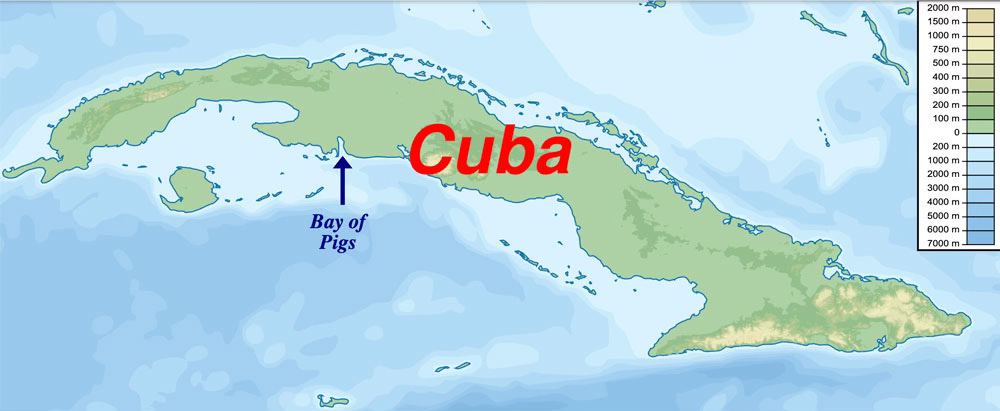
The anti-Castro forces in 1960s America were weakened by the failed Bay of Pigs Invasion (1961) but then reinvigorated by the Russian-Cuba Missile Crisis (1962).
A generation of Cuban escapees and refugees help form the views of their American political descendants and American policy towards Cuba. That continues today. Secretary of State Marco Rubio is very clear about his desire to see regime change in Cuba as well as Venezuela.
Remember that the recent tanker seizures by US forces impact Cuba directly and make life on the island nation progressively harder every day. Here’s a recent story about possible collapse in Cuba:
“U.S. Oil Blockade of Venezuela Pushes Cuba Toward Collapse” | WSJ, https://www.wsj.com/world/americas/u-s-oil-blockade-of-venezuela-pushes-cuba-toward-collapse-75289b5b
At present, a pair of multimillion dollar disputes hang over the US Cuba policy issue.
The cases, which the Supreme Court has agreed to hear, involve seeking a ruling on the scope of the 1996 Helms-Burton Act. That act reinforced the US embargo against Cuba and enabled lawsuits “against anyone who ‘traffics’ in property confiscated by the Cuban government” after Fidel Castro’s takeover. The Hill reported in October on the two cases:
In the first, Exxon is suing Cuban state-owned companies. In the other, the company that built and operated the piers at Havana’s port is seeking to reinstate a $440 million award it won against some of the world’s biggest cruise lines.
(“Supreme Court takes up disputes over seized Cuba property” | The Hill, https://thehill.com/homenews/5536687-havana-docks-cruise-lawsuit/)
Reuters provides further details on the two cases, which address property seizures in 1960:
“US Supreme Court to hear Exxon bid for compensation from Cuban entities” | Reuters, https://www.reuters.com/business/energy/us-supreme-court-hear-exxon-bid-compensation-cuban-entities-2025-10-03/
The Supreme Court will take up both cases on February 23, 2026.
Readers are encouraged to peruse the timeline at the end of this commentary for more information about Cuban history from Castro to the present. I would also like to point readers to Stephen Bryen’s excellent Substack post from yesterday, pondering the very question I raised today.

Personal Reflections
I’ve made four trips to Cuba. Three trips occurred while I was chair or co-chair of a GIC delegation (www.interdependence.org ) that traveled under US State Department rules during both Trump’s first term and Biden’s administration. Our GIC delegation meetings were at the ministerial level and included the Cuban Central Bank on three occasions. They occurred under Raul Castro’s governance and under the post-Castro regime. (A link to the US embassy in Cuba for travel information is found here: “Traveling to Cuba-U.S. Embassy in Cuba.”)
On the last delegation trip, my colleagues and I visited the Bay of Pigs. According to Fidel Castro’s former bodyguard, the late Juan Reinaldo Sánchez, Castro lived in great luxury and had a private island called Cayo Piedra in the Bay of Pigs, replete with “mansions, guest houses, a heliport, dolphinarium, turtle lagoon, his luxury yacht Aquarama – a gift from Leonid Brezhnev – and deep-sea fishing speedboat.” Today, one is greeted by a seaside resort near the museum.
The museum and history tell the Bay of Pigs story from the Cuban perspective. The 1979 book Bay of Pigs, by Peter Wyden, offers a different depiction. Our group interviewed a Cuban survivor. Here’s the photo.
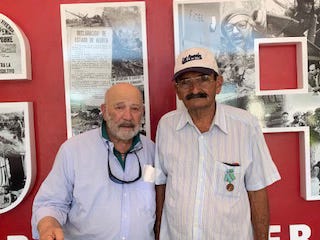
He described the attack and the battle that he experienced as a young soldier in Castro’s army. His account gave our group a third perspective. In the end we shook hands and exchanged genuine wishes for a better world and more peaceful understanding.
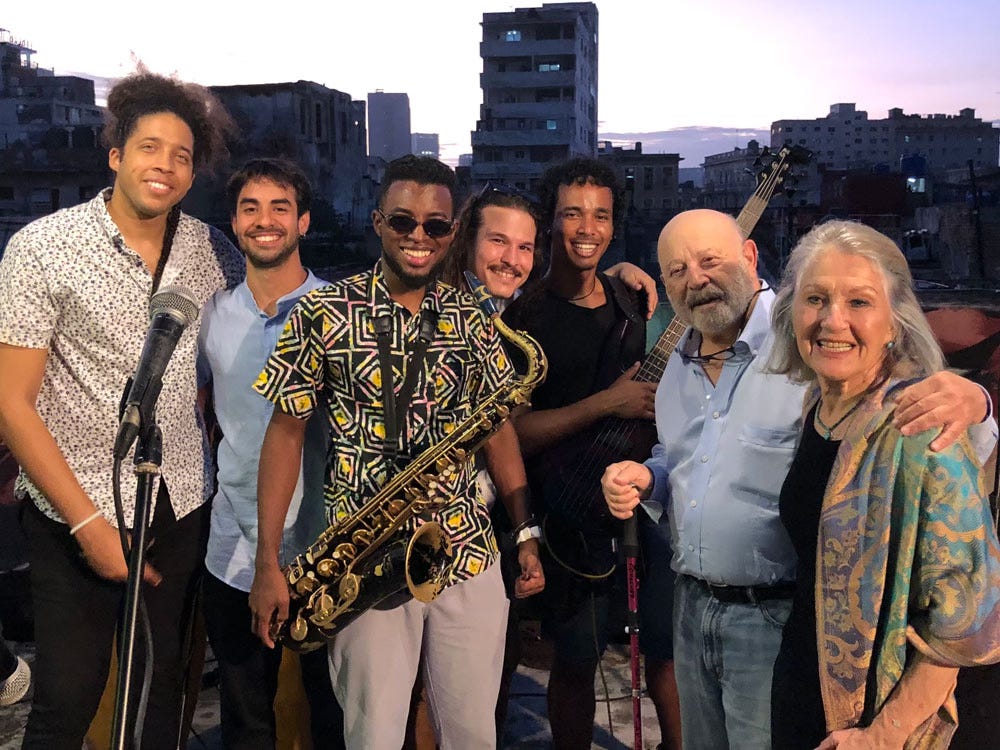
My takeaway from the four trips to Cuba is clear for me. The people are friendly and don’t want war. They also have no say in their government’s policy decisions. Those that were able to leave have left or tried to leave. Others I met would like to emigrate. I did not sense any animosity against Americans from the citizens. That includes these jazz musicians who played a private rooftop concert for our group in Havana. They were terrific.
One last snippet and then the partial timeline from Castro to present: When we were in the central bank, I learned that Che Guevara was the first central bank president after Fidel Castro seized power. I asked how that appointment happened. The story goes that Castro convened a meeting and was told by his advisors that he needed a good economist to head the central bank. He yelled across the room and asked Che G. if he was a good economist. Che said “yes.” Later, Central Bank President Guevara was asked why he said yes, as he was not an economist and had no training. He answered. “The room was noisy. I thought he asked me if I were a good Communist. So I said, “Yes”.
Rick Newman wrote for Yahoo! Finance about one of our GIC trips, back in 2023, sharing insights from the experience:
“7 surprises from a visit to Cuba” | Yahoo! Finance, https://finance.yahoo.com/news/7-surprises-from-a-visit-to-cuba-175126441.html
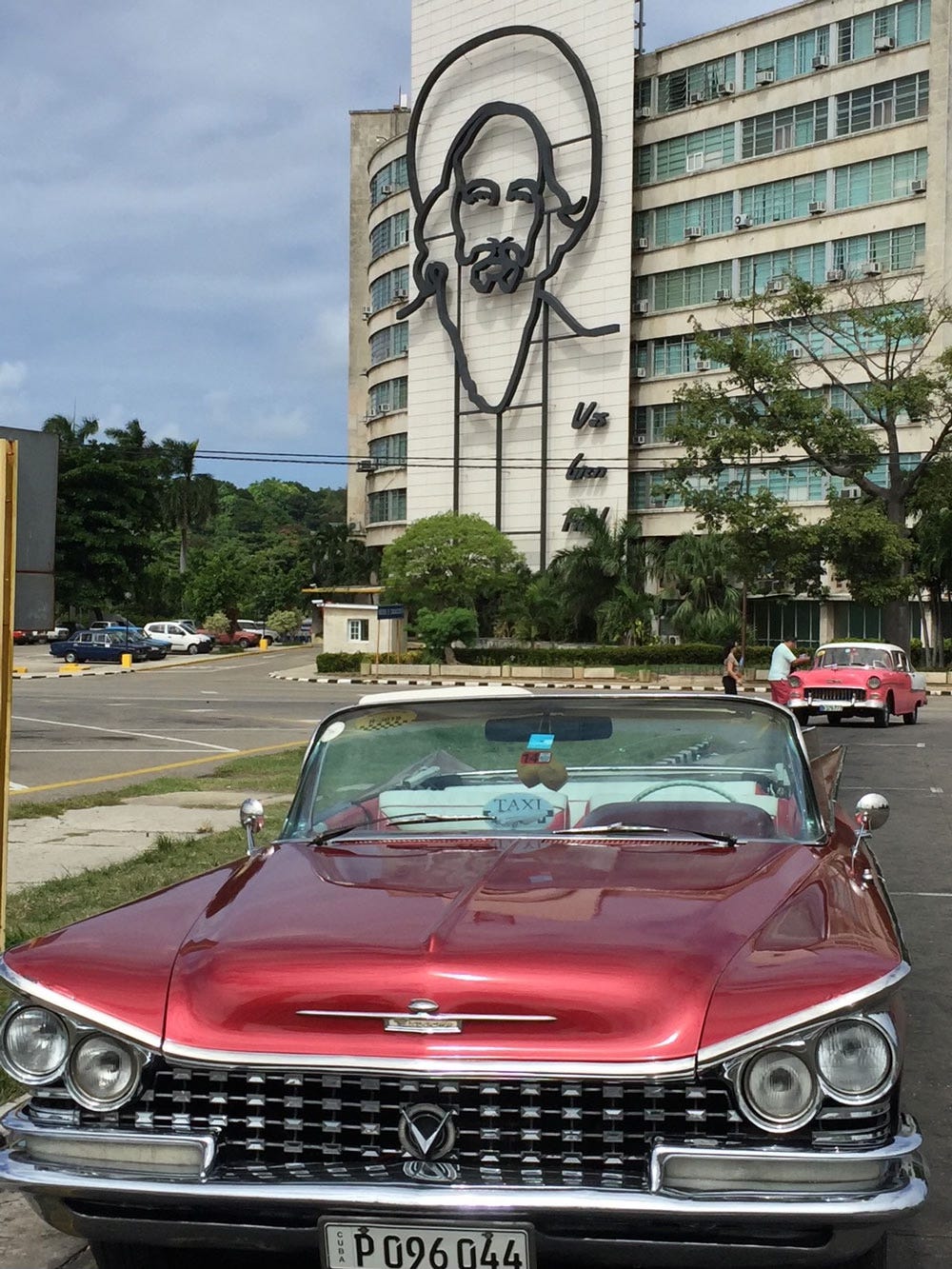
Let’s close with a photo of a memory from one of my visits, followed by the timeline.
Cuba Timeline, 1953–2025
1953 – Fidel Castro’s communist Cuban revolution begins.
1959 – President Batista flees the country as Castro seizes power, turning Cuba into a communist state.
1960 – Cuba confiscates Cuban assets of a subsidiary of Exxon (Standard Oil). US imposes a trade embargo on Cuba.
1961 – Bay of Pigs invasion. US-backed Cuban exiles attempt to overthrow Castro and fail.
1962 – Cuban missile crisis. Cuba houses Soviet nuclear missiles on island, causing intense political tensions. Agreement is reached in which the US removes its nukes from Turkey in exchange for the Soviet removal of theirs in Cuba.
1965 – Castro, in agreement with the US, allows any Cubans wishing to leave to do so, known as the Freedom Flights.
1968 – The Cuban government nationalizes the last of the 56,636 private businesses remaining on the island.
1973 – Freedom Flights end; a total of 260,561 Cubans immigrated to the US.
1982 – US State Department adds Cuba to its list of state sponsors of terrorism as a result of Cuba’s support of revolutionary movements in Africa and Latin America.
1985 – Radio Marti (US radio station aimed at undermining Communist dictatorship in Cuba) airs for the first time — and continues to this day.
1991 – Collapse of the Soviet Union triggers an economic calamity in Cuba, as the island nation was mostly supported by Soviet subsidies.
1996 – U.S. Congress passes the Helms-Burton Act, otherwise known as the Cuban Liberty and Democratic Solidarity Act of 1996. Title III of the act permits US companies and citizens to sue parties that have profited from property confiscated by the Cuban government in 1959 or later. Congress left it to the president to decide when to activate Title III.
1999 – Cuba passes law of imprisonment for aiding US policies of anti-Communism.
2001 – Five Cuban spies are arrested in the US for spying and conspiracy to commit murder.
2002 – The last Russian military base in Cuba closes.
2004 – US President George W. Bush imposes family travel restrictions on US travel to Cuba.
2008 – Raul Castro, brother of Fidel, becomes president due to Fidel’s waning health.
2009 – US President Barak Obama lifts US restrictions on family travel to Cuba.
2015 – US President Obama removes Cuba from the State Department’s list of state sponsors of terrorism.
2016 – Fidel Castro passes away at the age of 90; US President Obama allows US commercial flights to Cuba for the first time since 1962.
2016 – Mysterious Havana Syndrome first appears in Cuba; US government personnel become sick with odd symptoms. Cuba is blamed by many in the US; however, the mysterious affliction continued for several years at US embassies across the globe.
2017 – President Trump cancels diplomatic agreements with Cuba made under the Obama administration.
2018 – Raul Castro retires; Miguel Diaz-Canel becomes president of Cuba and is first non-Castro to lead Cuba since the revolution.
2019 – Cuba ratifies a new constitution re-affirming devotion to communism. President Trump bans cruise ships and passenger vessels from visiting Cuba. In May, he activates Title III of the Helms-Burton Act. Subsequently, the Havana Docks Corporation, which claims to have owned the Havana Cruise Terminal in the 1950s—sues the Carnival Corporation, citing cruises that used the Havana docks from 2016 to 2019.
2021 – President Trump returns Cuba to the State Department’s list of state sponsors of terrorism a week before leaving office. Amid the COVID-19 pandemic, Cuba sees its largest protest against communism since 1959, triggered by shortages. The Biden administration implements harsh sanctions.
2023 – Miguel Diaz-Canel is re-elected as president, prolonging his presidency to 2028.
2024 – In July 2024, a case brought against Cuban corporations by Exxon Mobil is decided by the US Court of Appeals for the D.C. Circuit. The court concludes that the Helm-Burton Act does not apply. Exxon appeals to the Supreme Court.
2024 – In October 2024, an appeals court rules against Havana Docks, which had sued Carnival Corporation and three other cruise lines. The court noted that Havana Docks did not have outright ownership of the docks confiscated in 1960 but only the use of them until 2006. Havana Docks has appealed, with $440 million dollars at stake.
January 2025 – US President Joe Biden removes Cuba from the State Department’s list of state sponsors of terrorism a week before the end of his term, and incoming President Trump restores Cuba to the list upon taking office.
October 2025 – With encouragement from the Trump administration, the US Supreme Court agrees to consider the two appeals brought under the Helms-Burton Act. The court will consider both cases in February 2026.
December 2025 – US seizures of Venezuelan oil tankers threaten Cuba’s oil supply, as Cuba obtains a quarter of its oil from Venezuela.
Sources for expanded timelines and more detail
“Cuba profile – Timeline” | BBC, https://www.bbc.com/news/world-latin-america-19576144
“A Timeline of US-Cuba Relations” | History.com, https://www.history.com/articles/timeline-us-cuba-relations
“Chronology of U.S.-Cuba Relations” | Cuban Research Institute, Florida International University, https://cri.fiu.edu/us-cuba-relations/chronology-of-us-cuba-relations/
“US Supreme Court to hear Exxon bid for compensation from Cuban entities” | Reuters, https://www.reuters.com/business/energy/us-supreme-court-hear-exxon-bid-compensation-cuban-entities-2025-10-03/
“DC Circuit Decides Exxon Helms-Burton Lawsuit” | American Bar Association, https://www.americanbar.org/groups/business_law/resources/business-law-today/2025-april/dc-circuit-decides-exxon-helms-burton-lawsuit/
‘US appeals court sides with cruise lines in Havana docks suit” | Seatrade Cruise News, https://www.seatrade-cruise.com/finance-legal-regulatory/us-appeals-court-sides-with-cruise-lines-in-havana-docks-suit
David values thoughtful, reasoned, constructive responses from readers. To contact him, please send an email. The subject line should read “Response to [title of commentary].”
The complete Kotok Report archive can be found at www.kotokreport.com.